Warehouse Lighting Repair and High-Bay Service in DFW
Warehouse lighting repair across DFW
Lumen Lighting & Electric repairs warehouse and industrial lighting across Dallas–Fort Worth: high-bays that flicker, cycle or go dark, failed drivers and ballasts, occupancy sensors that won't behave, and whole rows that are out. We're a licensed Texas electrical contractor based in Lewisville (TDLR 35282). We find the cause, fix it, and work around your shifts so picking and shipping keep moving. Call 940-241-0215 for a service call.
Call 940-241-0215 · Request a service call
Helpful to have ready: the address, how many fixtures are out or flickering, the rough ceiling height, and any times we can't work on the floor.
Dark aisles and flickering fixtures slow picking, make labels harder to read and create safety problems for the people and equipment moving through the building. A few lights out is often a sign of something bigger, like a failing circuit, a sensor setting, or a batch of fixtures reaching the end of their life. We tell you which one it is, and what it takes to fix it.
High-bay troubleshooting: what we check
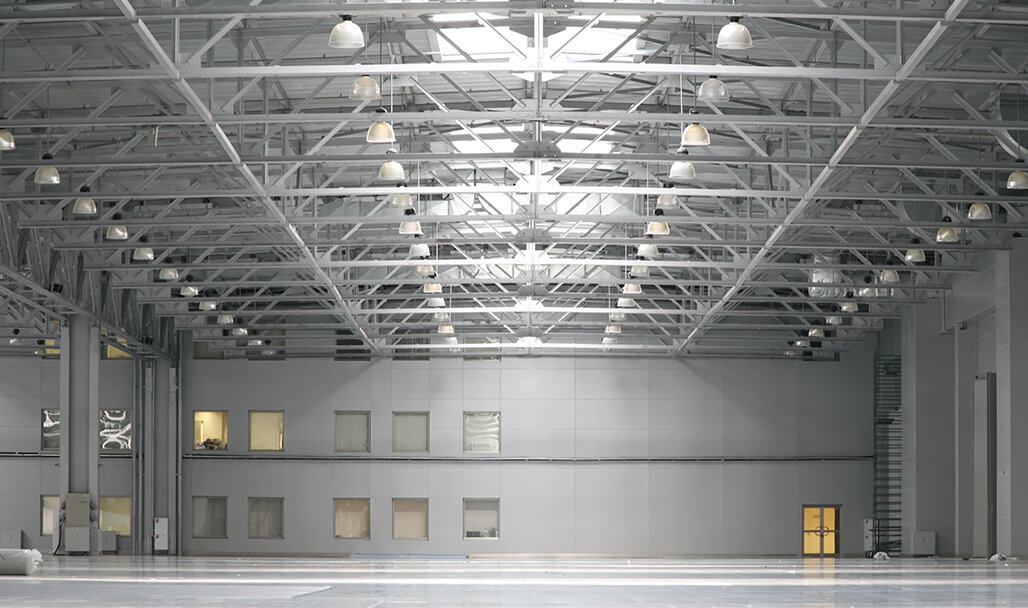
High-bay fixtures hang high above racking and open floor, so guessing at the problem gets expensive. We test first, then replace only what has actually failed. Here is what we look at when a warehouse calls about lights that are out, dim or flickering.
High-bays flickering or cycling on and off
One fixture flickering usually means a failing driver, a loose connection, or in older fixtures a failing ballast. A driver is the small power unit inside an LED fixture that turns building power into the steady power the LEDs need. A ballast does a similar job in older fluorescent and metal halide fixtures. A whole row flickering together, especially when big equipment starts up, usually points upstream to the circuit or panel. We test before replacing parts.
Fixtures out or a whole row dark
When one fixture is dark, the cause is often the driver, ballast, lamp or wiring. When a row or section is dark, it's more likely a breaker, a circuit, a contactor (the switch that turns a group of lights on and off) or a controls issue than every fixture failing at once. We trace it back to the cause and fix that. Replacing fixtures one by one when the real problem is a tripped breaker or a failed contactor wastes time and money, so we check the circuit first.
Drivers and ballasts
We test and replace failed drivers and ballasts with compatible parts, matched to the fixture and how it is wired. When a fixture is old, hard to get parts for, or keeps failing, we tell you plainly whether a repair still makes sense or whether your money is better spent on a replacement. If a whole batch of fixtures went in at the same time, one failure can be an early sign that others will follow, and we'll tell you if we see that pattern.
Occupancy sensors and controls
Lights that won't come on, won't shut off, or switch on and off too fast are often a sensor setting, a blocked or dirty sensor, a sensor too close to an air vent, or wiring. We check settings and wiring, then adjust, repair or replace the sensor so aisles light up when people are in them. For new or expanded controls, see our lighting controls & automation work.
Lights out or flickering? Call 940-241-0215 or request a service call.
Repair or replace? A straight answer
Repair makes sense when the fixture is in good shape and a driver, ballast, sensor or connection is the only problem. Swapping one failed part is usually the simplest way to get an aisle lit again.
An upgrade makes sense when fixtures are older metal halide or fluorescent, several are failing at once, parts are hard to find, or the light was never enough for the work being done under it. In those cases, repeat repairs can cost more over time than new fixtures. Dim, yellowed light from aging metal halide fixtures is also a common reason to look at new fixtures, even when nothing has fully failed.
We give you both options with clear pricing so you can decide. If replacing makes more sense for the whole building, we also handle commercial LED retrofits.
Repairs around live operations
Most DFW warehouses can't stop shipping so a few lights can be fixed. We plan repairs around how your building runs:
- Work by zone – aisle banks, packing areas or dock rows, so the rest of the floor keeps running
- Scheduled around your shifts – we work zone by zone at times that fit your operation
- Safety on the floor – equipment travel paths and closed-off work areas are coordinated with your team before we start
- Clear communication – scope and schedule confirmed before we start, and when we finish, we tell you what we found and what we fixed
Before any repair work, we confirm the areas we need, how long each zone will be closed off, and who on your team we check in with on site.
Ongoing warehouse lighting maintenance
After the repair, we can set up scheduled checks to catch failing fixtures, drivers and sensors before aisles go dark. That keeps small problems small and makes lighting costs easier to plan. For yard, pole and parking lot lights outside the building, our commercial lighting maintenance service covers that work with our own 45 ft and 75 ft bucket trucks. See also parking lot lighting.
Warehouse lighting upgrades
We also plan and install high-bay and low-bay LED upgrades for warehouses and industrial buildings across DFW, sized to your aisles, packing areas and docks rather than swapped one-for-one. Tall open and racked areas usually call for high-bays; lower ceilings and task areas may need low-bay or linear fixtures. More detail is on our high-bay lighting page.
Light-level targets are set after a site walk. We follow IES recommendations for warehouse applications and set targets for your aisles and packing lines from what we see on site, not from a generic chart. Where traffic is uneven, occupancy controls can cut run time in low-use aisles without leaving active pick paths underlit. Dock lights, exterior fixtures, security lighting, and exit and emergency lighting can be included with the interior work or handled separately.
Savings depend on what you have now, your hours of operation and your electricity rates. The path is simple: site walk → estimate → proposal, with fixtures, controls and install staging spelled out. ESCOs and general contractors that manage the customer relationship can use us for labor-only installs through our ESCO labor partner program.
Planning an upgrade? Request a quote.
DFW service area
We're based at 1671 Riverview Dr. Ste. 208 in Lewisville and handle warehouse lighting repairs and upgrades across Dallas–Fort Worth, including:
Multi-site owners and partners also use us for warehouse lighting installs across Texas. See all the cities we serve.
Why facility managers call Lumen
- Lighting specialist – Warehouse and high-bay repair, upgrades, controls and maintenance, not a vague "we do all electrical" pitch.
- 75 years combined experience – Commercial and industrial lighting work across DFW and Texas.
- Owner involvement – Dylan Taylor stays engaged on conditions, expectations and closeout.
- Licensed – TDLR 35282. Regulated by the Texas Department of Licensing and Regulation.
Warehouse lighting repair FAQs
Why are my warehouse high-bay lights flickering?
Usually a failing driver or ballast or a loose connection in that fixture. If a whole row flickers together, especially when large equipment starts, the cause is more likely the circuit or panel. We test to find which before replacing parts.
Can LED high-bay lights be repaired, or do they have to be replaced?
Many can be repaired. A failed driver, sensor or connection can often be replaced on its own. If a fixture is old, parts are hard to find, or several are failing, an upgrade may cost less over time. We'll give you both options.
Why is a whole row of warehouse lights out?
When a full row or section goes dark at once, the cause is usually a breaker, circuit, wiring or controls issue, not every fixture failing together. We trace the circuit to find the cause.
Why do our high-bays turn on and off by themselves, or never shut off?
Most often it's an occupancy sensor issue: the time delay setting, a sensor blocked or near an air vent, or wiring. Fixtures that shut off after running a while can also be overheating or near the end of their life. We check the sensor and the fixture.
What should I have ready before a service call?
The address, which areas or rows are affected, whether lights are out or flickering, and the fixture type if you know it. Call 940-241-0215 and tell us what's out. We'll set up a service call and give you a clear plan to fix it.
Can you repair high-ceiling lights without shutting down the warehouse?
Yes. We work zone by zone, scheduled around your shifts, and coordinate equipment travel paths and closed-off areas with your team.
How do we request a warehouse lighting repair?
Call 940-241-0215 or request a service call through our contact form. Tell us the address, how many fixtures are out or flickering, the rough ceiling height and fixture type if you know them, and any times we can't work on the floor.
Get your warehouse lights working again
Lights out, flickering, or a whole row dark? Call us for a service call. Planning a bigger upgrade? Request a quote and we'll walk the building and give you a clear plan.
Call 940-241-0215 · Request a quote
Other services: office lighting · commercial electrical services
Lumen Lighting & Electric · 1671 Riverview Dr. Ste. 208, Lewisville, TX 75056 · 940-241-0215 · info@lumenlightingandelectric.com · TDLR 35282